
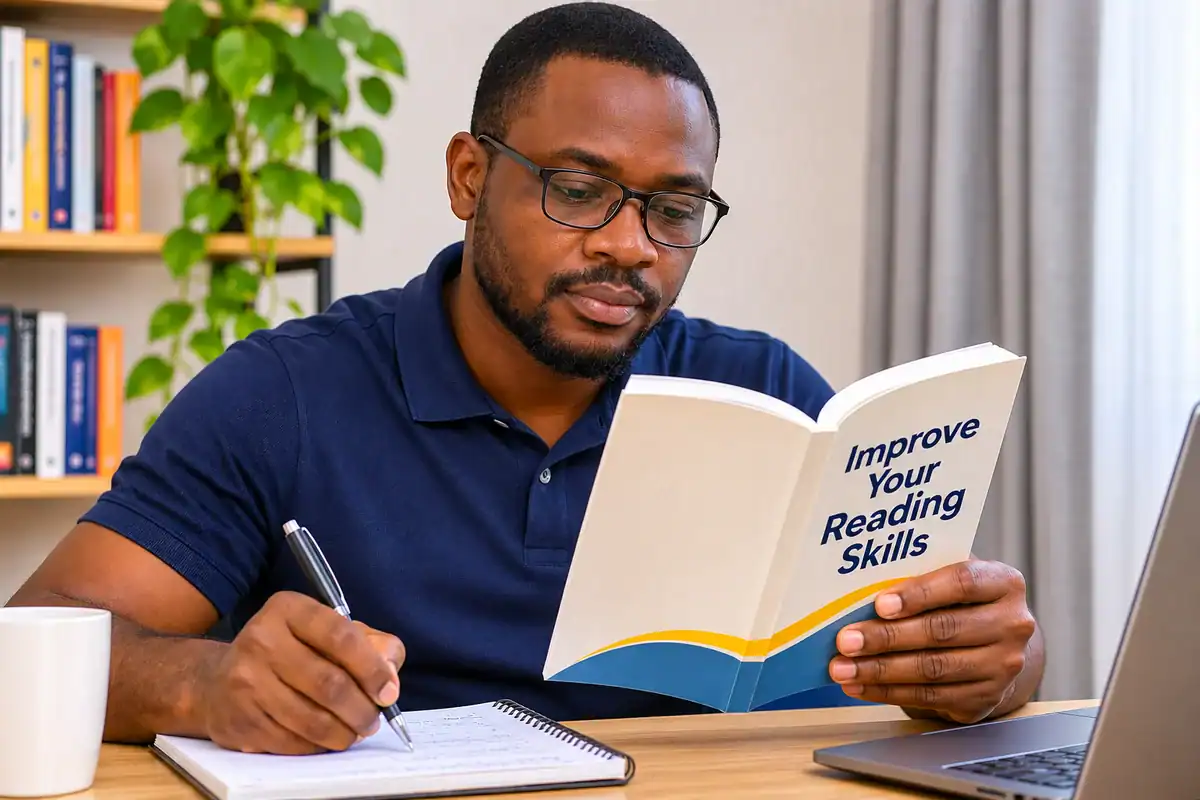
Do you want to improve your reading skills but don’t know where to begin?
Perhaps you can read simple sentences but struggle with longer passages. Maybe you pronounce words correctly but find it difficult to understand what you have read. Or perhaps you want to become a more fluent and confident English reader.
Whatever your current reading level, regular practice can help you improve.
Reading is a skill that develops through practice. You do not have to spend several hours reading every day. Even 15 to 20 minutes of focused practice can help you work on important reading skills.
In this article, you will discover 10 simple reading exercises for adults and teenagers. Each exercise focuses on a particular skill, including word recognition, pronunciation, fluency, vocabulary and reading comprehension.
Why Are Reading Exercises Important?
Reading exercises give you an opportunity to practise specific skills rather than simply reading without a clear purpose.
For example:
- Phonics exercises help you recognise and pronounce unfamiliar words.
- Vocabulary exercises help you understand new words.
- Fluency exercises help you read more smoothly.
- Comprehension exercises help you understand and remember information.
If you are still learning basic reading skills, it is important to start with exercises that match your current ability.
You do not have to begin with difficult books or long passages. Start with simple activities and gradually increase the difficulty as you improve.
10 Simple Reading Exercises for Adults and Teenagers
Here are 10 practical exercises you can try at home.
1. Practise Letter Sounds and Phonics
If you struggle to recognise or pronounce unfamiliar words, begin by practising phonics.
Phonics helps you understand the relationship between letters and sounds. It teaches you how to use these sounds to read words.
For example:
- sh – ship
- ch – chair
- th – think
- ai – rain
- ee – green
Your exercise:
- Choose five letter sounds or letter combinations.
- Say each sound aloud.
- Find three words containing each sound.
- Read the words aloud.
- Write the words in a notebook.
Practise regularly until you become comfortable recognising these sounds in different words.
This exercise is particularly useful for adults and teenagers who are still developing their foundational reading skills.
2. Practise Blending Sounds to Read Words
Blending means joining individual sounds together to pronounce a complete word.
For example:
- c – a – t = cat
- p – i – n = pin
- sh – i – p = ship
- fl – a – g = flag
Your exercise:
Choose five simple words. Break each word into its sounds, then blend the sounds together to read the complete word.
For example:
/m/ – /a/ – /p/ = map
Start with short words and gradually practise longer words and words containing consonant combinations.
Remember that the goal is to become comfortable working out unfamiliar words, not simply memorising a list.
3. Read a Short Passage Aloud
Reading aloud helps you practise pronunciation, accuracy and fluency.
Choose a short passage that is appropriate for your reading level.
Read it slowly and pay attention to:
- Correct pronunciation.
- Pauses at commas and full stops.
- Clear expression.
- Words that you find difficult.
Read the same passage a second time.
Notice whether you can read it more smoothly and confidently.
Do not rush to increase your speed. Accuracy and understanding should come first.
4. Practise Reading Phrases Instead of Individual Words
Some readers concentrate on one word at a time. This can make reading slow and difficult.
An effective exercise is to practise reading groups of words that form meaningful phrases.
For example, instead of reading:
“The / young / man / walked / to / the / market.”
Practise reading:
“The young man / walked to the market.”
Your exercise:
Divide these sentences into meaningful groups:
- The woman / opened the door.
- My brother / works in a hospital.
- The children / played football after school.
Read each group smoothly while paying attention to its meaning.
With practice, this can help you develop better reading fluency.
5. Learn Five New Words Every Day
A limited vocabulary can make reading difficult because unfamiliar words interrupt your understanding.
One way to improve is to learn a few new words every day.
Your exercise:
Create a vocabulary notebook with four columns:
| New word | Meaning | Example sentence | My own sentence |
|---|---|---|---|
| Reluctant | Unwilling | She was reluctant to speak. | I was reluctant to leave. |
| Generous | Willing to give | He is a generous man. | My neighbour is generous. |
| Improve | To make better | Practice can improve reading. | I want to improve my English. |
Try to use each new word in your own sentences.
Learning a word is more useful when you understand its meaning and know how to use it.
6. Read One Paragraph and Summarise It
Reading comprehension is the ability to understand the meaning of written information.
You can practise this skill by reading a short paragraph and explaining its main idea in your own words.
Your exercise:
Read this paragraph:
“Regular exercise is important for good health. It helps strengthen the muscles, improves physical fitness and can reduce the risk of some health problems. Walking, swimming and cycling are examples of physical activities people can include in their daily routines.”
Now answer these questions:
- What is the paragraph mainly about?
- Mention two benefits of regular exercise.
- Name two physical activities mentioned in the paragraph.
After answering, explain the paragraph in one or two sentences without looking at the original text.
This exercise helps you move beyond pronouncing words to understanding their meaning.
7. Practise Finding the Main Idea
Every paragraph usually communicates a central idea. The other sentences provide explanations, examples or supporting information.
Learning to identify the main idea can help you understand longer passages.
Your exercise:
Read this paragraph:
“Many adults use the internet to learn new skills. They can watch educational videos, read articles and take online courses. These resources make it possible for people to continue learning outside traditional classrooms.”
Ask yourself:
What is the main idea?
A. Adults enjoy watching videos.
B. The internet provides opportunities for adults to learn new skills.
C. Traditional classrooms are no longer useful.
The correct answer is B.
Practise this activity with different paragraphs until you become comfortable identifying the main idea.
8. Read a Passage and Answer Questions
This is one of the most useful exercises for improving reading comprehension.
Read the passage below.
Passage:
“Mary works in a small office. Every morning, she arrives early and organises the documents on her desk. She believes that planning her activities helps her complete her work on time. During her lunch break, she usually reads a book or listens to educational programmes.”
Questions:
- Where does Mary work?
- What does she do every morning?
- Why does she plan her activities?
- What does she usually do during her lunch break?
Try answering without looking back at the passage.
Afterwards, check your answers against the information in the text.
As you improve, practise answering questions that require you to make simple conclusions rather than just locating information directly.
9. Read a Passage Twice and Compare Your Understanding
Sometimes, you may finish reading a passage without understanding all its information.
Reading the passage again with a clear purpose can help.
Your exercise:
- Choose a short article or passage.
- Read it once without stopping too often.
- Write down what you think the passage is about.
- Read it a second time.
- Look for details you missed during the first reading.
- Write a better summary.
Compare your first summary with the second one.
Did you understand more information the second time?
This exercise helps you become more aware of your understanding and teaches you to reread when necessary.
10. Read Something You Enjoy Every Day
Reading practice becomes easier to maintain when you choose topics that interest you.
You could read about:
- Business and entrepreneurship.
- Health and fitness.
- Science and technology.
- Sports.
- History.
- Personal development.
- Everyday life.
Choose materials that are suitable for your current reading level.
Start with 10 to 15 minutes of daily reading. As you become more comfortable, gradually increase the time or choose more challenging materials.
After reading, explain what you have learned to someone else or write a short summary.
The aim is to develop a consistent reading habit while improving your understanding.
A Simple 20-Minute Daily Reading Practice Plan
You can combine some of the exercises above into a daily routine.
| Activity | Time |
|---|---|
| Practise phonics or difficult words | 4 minutes |
| Read a short passage aloud | 5 minutes |
| Learn new vocabulary | 3 minutes |
| Read and summarise a paragraph | 4 minutes |
| Answer comprehension questions | 4 minutes |
| Total | 20 minutes |
You can adjust the activities according to your reading level.
If you already recognise words comfortably, spend less time on basic phonics and more time on vocabulary, fluency and comprehension.
What If You Are an Adult Who Struggles With Basic Reading?
Some adults need more than ordinary reading practice. They may struggle with letter sounds, blending, recognising words or reading simple sentences.
If this describes you, it is important to build your reading skills in the correct order.
Begin with letter sounds, practise blending sounds into words, learn common spelling patterns and gradually move towards sentences and passages.
Our guide, How Adults Can Learn to Read: A Step-by-Step Guide, explains how adults can develop their reading skills from the beginning.
You can also explore 5 Simple Strategies to Boost Reading Skills for Adults and Teens for additional practical ways to improve reading.
How Reading Made Easy Can Help
If you need structured support with foundational reading skills, the Reading Made Easy resources provide phonics lessons and guided reading exercises to help you develop your ability to recognise and read words.
You can explore the Reading Made Easy resources on our website to find learning materials that suit your needs.
Remember that phonics is an important foundation, but becoming a confident reader also requires vocabulary development, fluency and comprehension practice.
Final Thoughts
Improving your reading skills does not have to be complicated. Start with exercises that match your current ability and practise consistently.
You may not notice a dramatic improvement after one day, but regular practice can help you become more accurate, fluent and confident.
Choose one or two exercises from this article and begin today. As you improve, introduce more challenging activities.
The most important thing is to keep practising. Every step forward counts.