
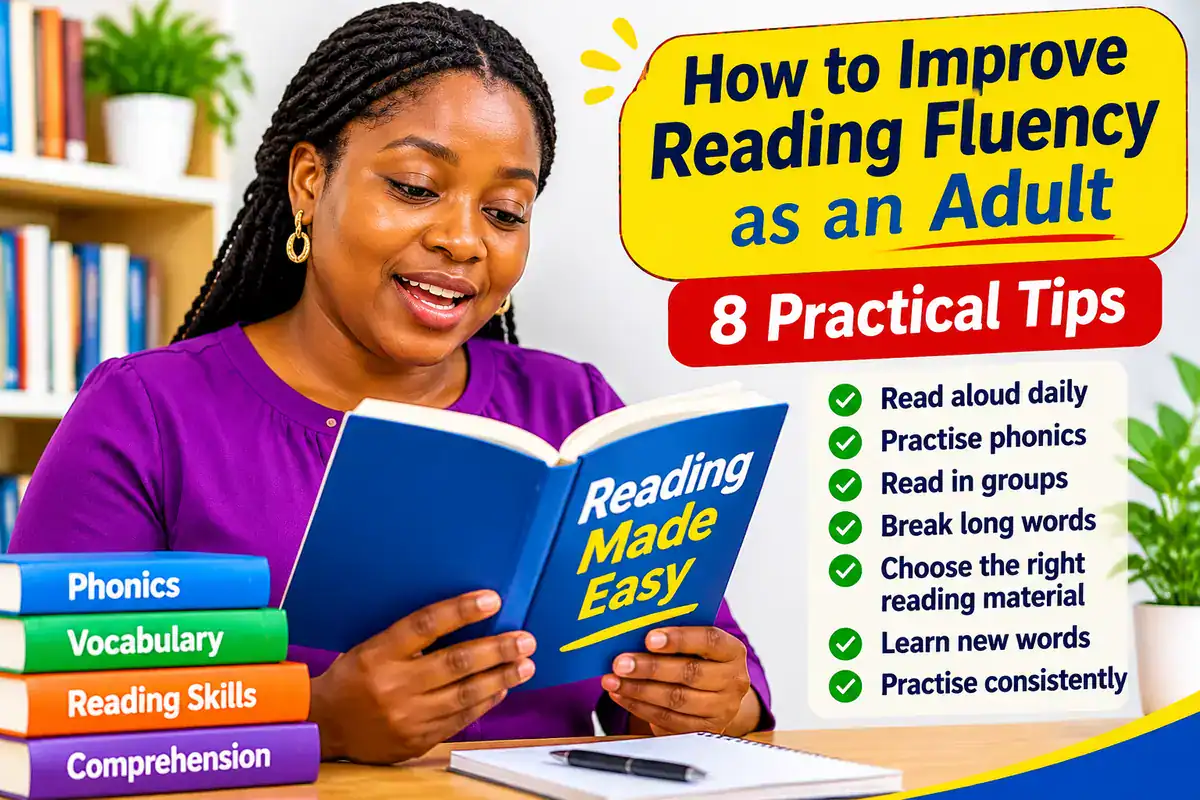
Can you read a sentence but find yourself stopping several times to work out the words? Do you read very slowly, struggle to connect words smoothly, or feel uncomfortable when someone asks you to read aloud?
You are not alone. Many adults and teenagers experience these difficulties when learning to read or improving their reading skills.
The good news is that reading fluency can improve with regular, structured practice. You do not have to rush or compare yourself with other readers. What matters is learning to read words accurately, smoothly and with better understanding.
In this guide, you will discover eight practical ways to improve your reading fluency, even if you are starting with basic reading skills.
What Is Reading Fluency?
Reading fluency is the ability to read words accurately, at an appropriate pace, and with expression.
A fluent reader does not need to stop after every word to work out what it says. Instead, the reader recognises familiar words more easily, connects them smoothly and pays attention to the meaning of the passage.
Reading fluency has three important parts:
- Accuracy: Reading words correctly without frequently guessing or making mistakes.
- Speed: Reading at a comfortable pace without unnecessary pauses.
- Expression: Using appropriate pauses, emphasis and tone when reading sentences.
Reading quickly does not automatically mean you are fluent. It is better to read accurately and understand what you are reading than to rush through a passage without understanding it.
Why Do Some Adults Struggle with Reading Fluency?
There are several reasons an adult may find reading difficult.
1. Weak phonics skills
If you have not developed a strong understanding of letter sounds and how to blend them, unfamiliar words can be difficult to decode.
2. Limited word recognition
When you frequently encounter unfamiliar words, you may need to stop and sound them out. This can interrupt the flow of your reading.
3. Difficulty reading long words
Long words can be intimidating when you do not know how to break them into smaller parts. Learning to divide words into syllables can make them easier to read.
4. Lack of regular practice
Reading is a skill that improves through consistent practice. If you rarely read, recognising words and reading smoothly may remain difficult.
5. Fear of making mistakes
Some adults avoid reading aloud because they feel embarrassed about making mistakes. Unfortunately, avoiding reading practice can make it harder to develop confidence.
The solution is not to force yourself to read faster. It is to strengthen the skills that make fluent reading possible.
8 Practical Ways to Improve Reading Fluency as an Adult
1. Strengthen Your Phonics Skills
Phonics helps you understand the relationship between letters and sounds. It teaches you how to recognise letter patterns and blend sounds to read words.
For example:
- c-a-t = cat
- s-u-n = sun
- sh-i-p = ship
- ch-i-n = chin
If you struggle to recognise unfamiliar words, return to the basic sounds and practise blending them.
Do not assume that phonics is only for children. Adults can also benefit from learning how letters and sounds work together.
2. Practise Reading Aloud Every Day
Reading aloud is one of the practical ways to develop reading fluency.
When you read aloud, you become more aware of the words you are reading, the sounds you produce and the places where you pause.
Start with a short passage that is not too difficult. Read it slowly and carefully. If you come across a difficult word, stop, work it out and continue.
Try reading aloud for 10 minutes every day.
You can also record yourself reading and listen afterwards. This can help you notice words you mispronounced, unnecessary pauses and areas where you need more practice.
3. Read the Same Passage More Than Once
Repeated reading is a useful way to improve fluency.
Choose a short paragraph and read it several times.
- First reading: Concentrate on recognising and pronouncing the words correctly.
- Second reading: Try to read the words more smoothly.
- Third reading: Pay attention to pauses and expression.
- Fourth reading: Focus on understanding the meaning of the passage.
Do not rush through the exercise. The purpose is to become more comfortable with the words each time you read them.
4. Learn to Read Words in Groups
When you are beginning to read, you may try to read one word at a time. This can make reading slow and tiring.
As your skills improve, practise recognising groups of words that belong together.
For example, instead of reading:
The / man / went / to / the / market.
Try reading:
The man / went to the market.
You can gradually practise longer groups:
The young man / went to the market / to buy some food.
Reading in meaningful groups helps your reading sound more natural and makes it easier to follow the meaning of sentences.
5. Learn How to Break Long Words into Syllables
Long words can interrupt your reading when you do not know how to pronounce them.
One useful strategy is to divide a long word into smaller parts called syllables.
For example:
- information: in-for-ma-tion
- education: ed-u-ca-tion
- understanding: un-der-stand-ing
- responsibility: re-spon-si-bil-i-ty
Practise reading each part before joining the parts together to say the complete word.
If you want more guidance, read our article on how to read long words.
6. Read Material That Matches Your Current Level
Choosing reading material that is too difficult can discourage you.
If you are still learning basic reading skills, begin with short sentences and simple passages. As you become more confident, gradually move to longer sentences and more challenging texts.
Your reading material should challenge you without overwhelming you.
You can practise with:
- Short stories
- Simple news articles
- Everyday conversations
- Short paragraphs about familiar subjects
- Instructions and notices
The goal is to build your skills gradually.
7. Learn New Words and Their Meanings
Vocabulary plays an important role in reading fluency.
When you understand the words in a passage, you can recognise them more easily and concentrate on the meaning of what you are reading.
Whenever you meet an unfamiliar word:
- Write the word down.
- Find out how to pronounce it.
- Break it into smaller parts if necessary.
- Learn its meaning.
- Use it in a sentence.
- Read the sentence aloud.
Try learning three to five useful words each day. Review previously learned words so that you do not forget them.
8. Practise Consistently Instead of Reading for Hours Occasionally
You do not need to spend several hours reading in one day to improve.
A short daily practice session can be more useful than reading for a long time once a week.
Set aside 15 to 20 minutes each day. Use that time to practise phonics, read words, read sentences aloud and understand short passages.
Be patient with yourself. Reading fluency develops gradually, and progress may not happen at the same speed for everyone.
A Simple 20-Minute Daily Reading Fluency Routine
Here is a practical routine you can follow every day.
| Activity | Time |
|---|---|
| Practise letter sounds and blending | 5 minutes |
| Read words and difficult word patterns | 5 minutes |
| Read a short passage aloud | 5 minutes |
| Reread the passage and explain what it means | 5 minutes |
| Total | 20 minutes |
You can adjust the routine to suit your current reading level. If you find phonics difficult, spend more time strengthening your basic sound and blending skills before moving to longer passages.
How Long Does It Take to Improve Reading Fluency?
There is no fixed period for everyone.
Some people notice improvements after a few weeks of consistent practice, while others need several months or longer. Your progress depends on your starting level, the skills you need to develop and how regularly you practise.
Rather than measuring your progress only by how fast you read, look for other improvements:
- You recognise more words without sounding them out.
- You make fewer mistakes when reading.
- You can read sentences with fewer unnecessary pauses.
- You understand more of what you read.
- You feel more comfortable reading aloud.
These are meaningful signs that your reading skills are developing.
What If You Still Struggle to Read Fluently?
If you continue to struggle, do not conclude that you cannot learn to read.
You may need to return to some foundational skills before concentrating on fluency. For example, if you cannot confidently recognise letter sounds or blend them into words, reading longer passages will remain difficult.
A structured learning programme can help you work through these skills in the right order.
You may also find our guide on how adults can learn to read helpful.
For more practical activities, see our article on simple reading exercises for adults.
How Reading Made Easy Can Help You Improve
Reading Made Easy is designed to help teenagers and adults who struggle with reading develop their skills step by step.
The programme uses phonics-based lessons to help learners understand letter sounds, blend sounds into words and progress towards reading sentences and longer words.
It includes learning materials, video lessons and exercises to support practice.
You do not have to remain stuck because reading has been difficult for you in the past. With the right guidance and consistent practice, you can continue building your reading skills.
Visit Reading Made Easy to learn more about the programme.
Final Thoughts
Improving reading fluency as an adult is possible, but it requires patience and consistent practice.
Start by strengthening your phonics skills, reading aloud, practising familiar passages and gradually increasing the difficulty of your reading material.
Do not focus only on speed. Aim to read accurately, smoothly and with understanding.
Give yourself time to improve. Every word you learn to read confidently is another step towards becoming a stronger reader.