
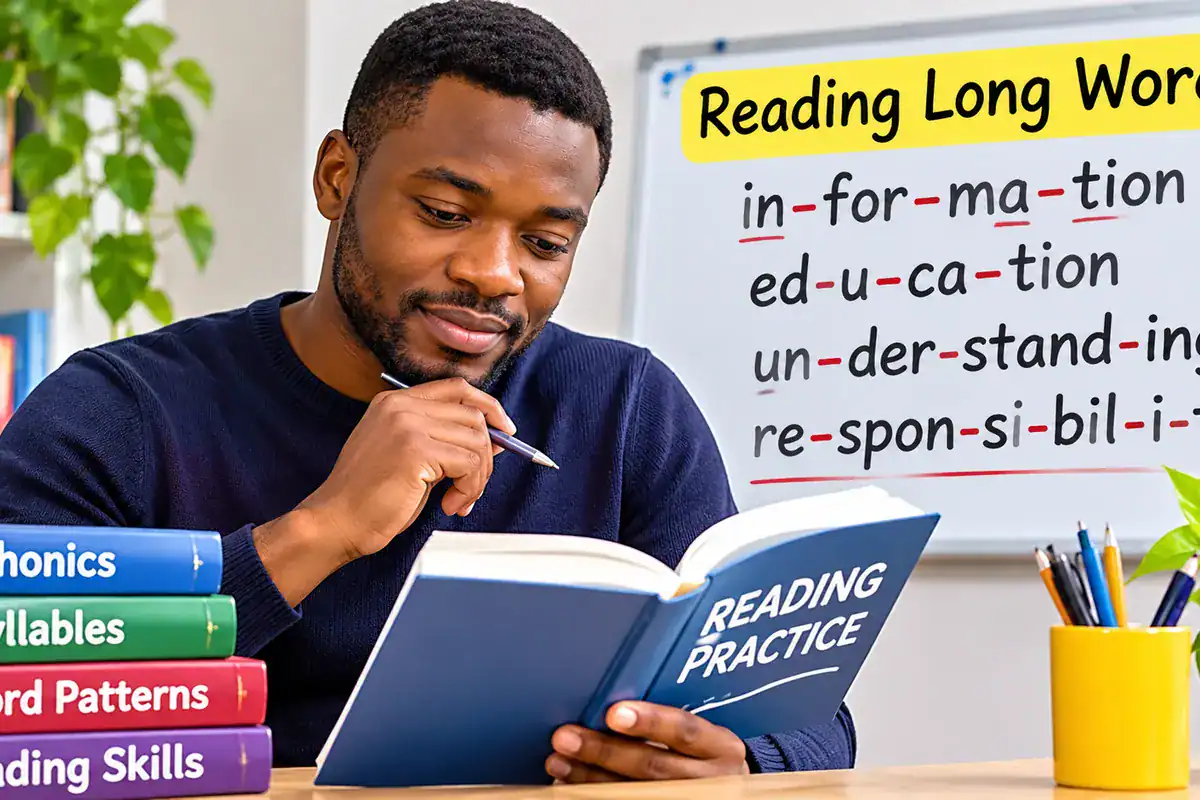
Do you find it easy to read short words but struggle when you come across longer words?
Perhaps you can read words such as cat, ship and hand, but words such as important, information, education and understanding make you stop.
If this happens to you, you are not alone. Many teenagers and adults who struggle with reading find long words particularly difficult. Sometimes, they try to guess the word, skip it completely or pronounce only part of it.
The good news is that you do not have to memorise every long word you encounter. You can learn strategies that help you break unfamiliar words into smaller, manageable parts.
In this article, you will discover seven practical ways to read long words more confidently.
Why Are Long Words Difficult to Read?
Long words can be difficult because they contain several letters, sounds and syllables. A reader may recognise the individual letters but struggle to put the sounds together in the correct order.
For example, the word information contains several syllables. Trying to read the entire word at once can feel overwhelming if you are not yet confident with longer words.
Some common difficulties include:
- Not recognising familiar letter patterns.
- Struggling to identify syllables.
- Finding it difficult to blend sounds smoothly.
- Not recognising prefixes and suffixes.
- Trying to read too quickly.
- Guessing words instead of decoding them.
The solution is to slow down and use a systematic approach.
7 Simple Strategies for Reading Long Words
1. Break the Word into Smaller Parts
One of the most useful ways to read a long word is to divide it into smaller parts.
These parts are called syllables. A syllable is a unit of pronunciation that contains a vowel sound.
Instead of trying to read a long word all at once, divide it into syllables and practise each part.
For example:
- ta-ble
- win-dow
- re-mem-ber
- in-for-ma-tion
Read each part slowly, then combine the parts to pronounce the complete word.
Practice: Choose five long words from a book or newspaper. Divide each word into syllables and read the parts before reading the complete word.
2. Look for Familiar Letter Patterns
Long words often contain smaller letter patterns that you may already know.
For example, recognising patterns such as tion, ing, ment, ight and ough can help you approach unfamiliar words.
Consider these examples:
- reading
- payment
- station
- bright
- thoughtful
When you recognise a familiar spelling pattern, you do not have to approach every letter as something completely new.
However, remember that the same spelling pattern can sometimes represent different sounds in different words. Always check the pronunciation in context.
3. Learn to Recognise Prefixes and Suffixes
Some long words become easier to read when you recognise their smaller meaningful parts.
A prefix is added to the beginning of a word, while a suffix is added to the end.
Examples of prefixes:
- unhappy = un + happy
- rewrite = re + write
- disagree = dis + agree
Examples of suffixes:
- helpful = help + ful
- careless = care + less
- movement = move + ment
Learning common prefixes and suffixes helps you recognise familiar parts inside longer words.
It can also help you understand the meanings of words.
4. Use Phonics to Decode Unfamiliar Words
Phonics teaches you how letters and groups of letters represent sounds.
When you understand phonics, you can use those sound patterns to work out unfamiliar words instead of depending entirely on memorisation.
For example, when reading a word such as sunshine, you can recognise and blend the smaller sound units:
- sun
- shine
Practise saying each part clearly before blending them together.
You should also review common vowel sounds, consonant combinations and letter patterns. These skills provide an important foundation for reading longer words.
If you need to strengthen your foundations, read our guide on how adults can learn to read step by step.
5. Pay Attention to the Vowel Sounds
Vowels play an important role in reading syllables and longer words.
The five main vowel letters are a, e, i, o and u. They can represent different sounds depending on the word and spelling pattern.
For example:
- cap and cape
- hop and hope
- bit and bite
When reading an unfamiliar word, look carefully at its vowel patterns. Avoid assuming that a vowel always makes the same sound.
Practise reading words with different vowel patterns until you become more familiar with them.
6. Read Slowly Before Increasing Your Speed
Many struggling readers believe they must read quickly to become good readers.
However, trying to read long words too quickly can lead to mistakes.
When you encounter a difficult word:
- Stop and look carefully at the word.
- Identify familiar letter patterns.
- Divide the word into manageable parts where possible.
- Pronounce each part.
- Blend the parts together.
- Read the complete sentence again.
Do not worry about speed at the beginning. Focus on reading the word accurately.
As your confidence and accuracy improve, your reading fluency can develop too.
7. Practise Long Words in Sentences
Reading individual words is useful, but you should also practise using them in sentences.
For example:
- The information was helpful.
- Education creates opportunities.
- The teacher explained the instructions.
- Understanding new words takes practice.
Read each sentence slowly. Then read it again, paying attention to the complete meaning.
Practising words in sentences helps you become more comfortable recognising them during everyday reading.
A Simple 10-Minute Daily Practice Routine
You do not need to spend hours practising long words. A short, consistent routine can help you develop your skills.
Try this 10-minute routine:
| Time | Activity |
|---|---|
| 2 minutes | Review familiar letter sounds and spelling patterns. |
| 3 minutes | Divide five long words into syllables. |
| 2 minutes | Practise blending the word parts. |
| 3 minutes | Read sentences containing the words. |
Repeat the routine regularly. As you improve, gradually introduce more challenging words.
Practice Exercise: Can You Read These Long Words?
Try reading the following words. Break them into smaller parts where possible, then pronounce the complete word.
Level 1
- Window
- Remember
- Fantastic
- Tomorrow
- Holiday
Level 2
- Information
- Education
- Important
- Understanding
- Responsibility
Do not rush. Take your time and practise each word until you can pronounce it confidently.
You can also write down the words that give you difficulty and return to them during your next practice session.
What If You Still Struggle with Long Words?
If you continue struggling with long words, you may need to strengthen some foundational reading skills.
For example, you may need more practice with:
- Letter sounds and phonics.
- Blending sounds to form words.
- Recognising common spelling patterns.
- Reading words with consonant combinations.
- Reading words containing more than one syllable.
It is important to identify the particular skill causing difficulty rather than simply trying to memorise more words.
If you are still building your reading foundation, our article on five simple strategies to boost reading skills for adults and teens provides additional practical guidance.
You may also find encouragement in our article, Is It Too Late to Learn to Read Properly as a Teenager or Adult?.
How Reading Made Easy Can Help
Learning to read longer words becomes easier when you understand how sounds, letters and spelling patterns work together.
Reading Made Easy provides structured phonics and reading lessons designed for teenagers and adults who want to improve their reading skills.
The programme combines reading books, video lessons and practice activities to help learners build their skills step by step.
You do not have to remain frustrated whenever you encounter a long word. With the right guidance and regular practice, you can become a more confident reader.
Visit Reading Made Easy to explore our reading resources and programmes.
Final Thoughts
Struggling to read long words does not mean you cannot become a confident reader.
Start by breaking unfamiliar words into smaller parts. Look for familiar letter patterns, practise phonics and blend the parts together.
Remember that accuracy comes before speed.
Give yourself time to practise, and do not be discouraged when a word takes several attempts. Every word you learn to decode is another step towards becoming a better reader.