
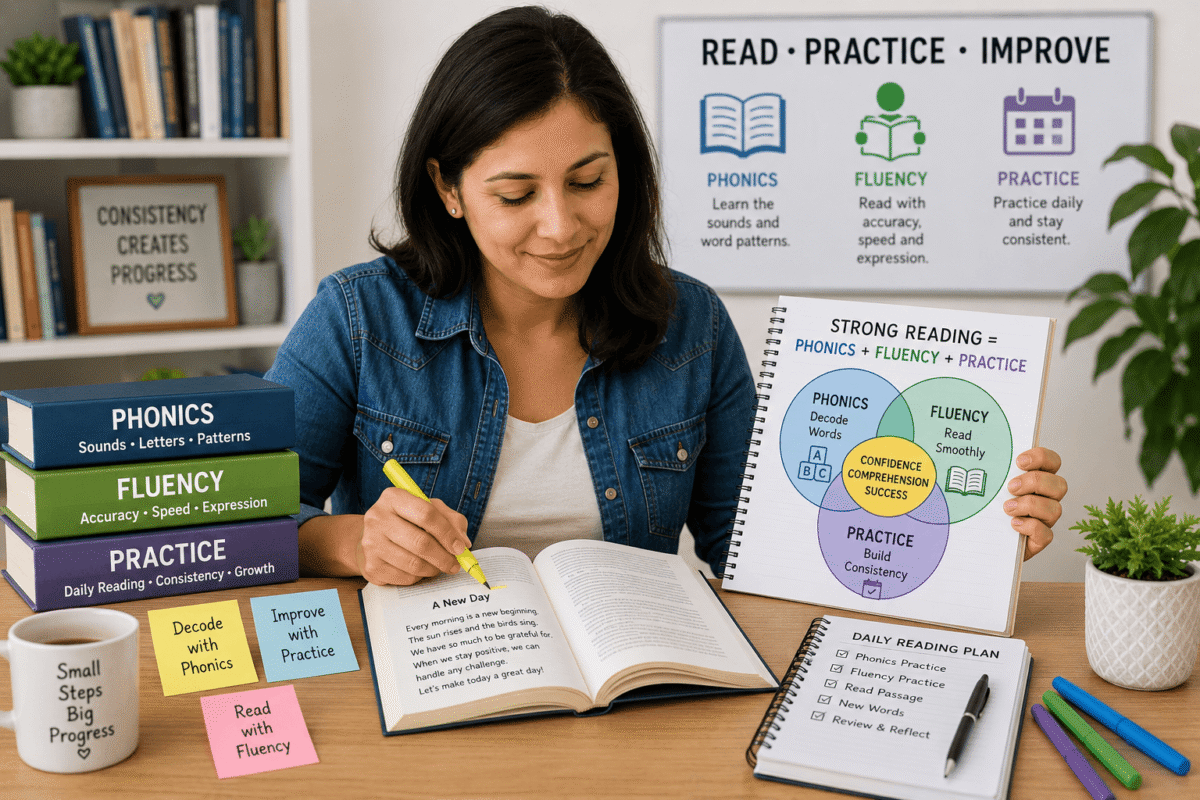
Many people want to improve their reading skills, but they are not sure where to focus their efforts.
Some spend all their time learning phonics.
Others focus only on reading practice.
Some try to read faster without building a strong foundation first.
As a result, progress often feels slow and frustrating.
The truth is that strong reading improvement usually comes from combining three important elements:
- phonics
- fluency
- practice
These three skills work together.
If one is missing, reading development becomes much more difficult.
Think of them as the legs of a stool.
Remove one leg and the stool becomes unstable.
The same thing happens in reading.
Phonics helps you decode words.
Fluency helps you read smoothly.
Practice strengthens both skills over time.
When these three areas are combined properly, reading becomes easier, faster, and more enjoyable.
What Is Phonics?
Phonics is the ability to connect letters and letter combinations to sounds.
For example:
- b says /b/
- m says /m/
- sh says /sh/
- ch says /ch/
Phonics helps readers sound out unfamiliar words.
Without phonics, many readers rely on guessing.
This often leads to mistakes and frustration.
When readers understand phonics, they can approach unfamiliar words with confidence.
Instead of guessing, they can work through the word step by step.
This is especially helpful when reading longer words.
If you struggle with long words, you may also enjoy reading How to Break Down Difficult Words Easily.
Learning how to break words into smaller parts is one of the most powerful reading skills you can develop.
What Is Fluency?
Fluency is the ability to read accurately, smoothly, and with understanding.
A fluent reader:
- recognizes words quickly
- pauses less often
- reads naturally
- understands what is being read
Many readers focus only on saying words correctly.
However, reading individual words correctly is not enough.
You also need to read smoothly.
When fluency improves, reading becomes less tiring and more enjoyable.
Fluency develops through repeated successful reading experiences.
This is why repeated reading can be so effective.
If you have not read it yet, see Why Reading the Same Passage Again Improves Fluency.
Repeated reading allows your brain to process words more efficiently and build stronger reading habits.
Why Practice Matters
Practice is the bridge between knowledge and skill.
A person may understand phonics rules.
A person may understand fluency.
But without practice, improvement remains limited.
Practice strengthens:
- word recognition
- decoding ability
- confidence
- reading speed
- comprehension
The more often you practice correctly, the stronger your reading skills become.
Practice helps transform reading skills from something you think about into something you do naturally.
Why Many Readers Struggle
Many struggling readers focus on only one area.
For example:
Too Much Phonics
Some readers spend all their time studying sounds but rarely read actual passages.
As a result, they know the rules but struggle to apply them.
Too Much Reading
Other readers read constantly but never learn how words work.
This often leads to guessing and repeated mistakes.
Inconsistent Practice
Some readers practice only when they feel motivated.
Unfortunately, improvement usually requires consistency.
This is why I recommend reading How to Stay Consistent When Learning to Read.
Small daily effort often produces better results than occasional long study sessions.
How These Three Skills Work Together
Imagine reading the word:
information
Without phonics, the word may seem overwhelming.
With phonics, you can break it into:
in-for-ma-tion
Now the word becomes easier to decode.
After reading it several times, your fluency improves.
Eventually, you recognize the word almost instantly.
Regular practice helps this process happen faster.
This example shows how phonics, fluency, and practice support each other.
Phonics helps you decode.
Fluency helps you recognize words more quickly.
Practice helps you remember and strengthen both skills.
A Simple Daily Reading Routine
One of the best ways to combine phonics, fluency, and practice is through a simple daily routine.
Step 1: Phonics Practice (5 Minutes)
Review:
- letter sounds
- blends
- digraphs
- common word patterns
Focus on one skill at a time.
Step 2: Fluency Practice (10 Minutes)
Read a short passage.
Then reread the same passage.
Notice:
- smoother reading
- fewer pauses
- stronger confidence
Step 3: Difficult Word Practice (5 Minutes)
Write down unfamiliar words.
Break them into smaller parts.
Use the techniques discussed in How to Break Down Difficult Words Easily.
Step 4: Daily Reading (10 Minutes)
Read something interesting.
Examples include:
- short stories
- articles
- books
- educational materials
Enjoyable reading helps maintain motivation.
Why Small Daily Practice Works Better
Many readers believe improvement requires long study sessions.
However, consistency is often more important than intensity.
Twenty minutes daily is usually better than two hours once per week.
Small reading sessions are easier to maintain.
They also reduce mental fatigue.
This approach supports steady long-term growth.
A Real Example
Let’s imagine a reader named Sarah.
Sarah struggles with longer words.
She often guesses words and loses confidence.
After learning phonics, she begins breaking words into smaller parts.
When she sees:
information
she reads:
in-for-ma-tion
Now she can decode it correctly.
Next, she begins rereading short passages.
This improves her fluency.
She starts recognizing words faster and reading more smoothly.
Then she commits to daily practice.
Even when she does not feel motivated, she continues reading for fifteen minutes each day.
A few months later, Sarah notices:
- fewer mistakes
- greater confidence
- smoother reading
- better understanding
Her improvement happened because she combined phonics, fluency, and practice.
How To Measure Progress
Many readers worry that they are not improving.
However, progress is often gradual.
Look for signs such as:
- fewer pauses
- easier word recognition
- better understanding
- stronger confidence
You may also find it helpful to read How to Know If You Are Improving Your Reading Skills.
That article explains several ways to track your progress accurately.
Why Adults and Teenagers Benefit From Phonics Too
Some people believe phonics is only for children.
This is not true.
Many teenagers and adults who struggle with reading never received strong phonics instruction.
Learning phonics later in life can significantly improve reading ability.
Strong readers continue using phonics whenever they encounter unfamiliar words.
Phonics remains useful throughout life.
Final Thoughts
Reading improvement does not come from phonics alone.
It does not come from fluency alone.
It does not come from practice alone.
Real progress happens when all three work together.
Phonics helps you decode words.
Fluency helps you read smoothly.
Practice strengthens both skills over time.
When you combine these three elements consistently, reading becomes easier, more enjoyable, and more effective.
Start small.
Stay consistent.
Trust the process.
Every reading session moves you forward.
Want a Complete Reading System?
If you want a structured step-by-step program that combines phonics, fluency, and practice into one simple system, my Reading Made Easy program can help.
👉 Get the Reading Made Easy Program Here
Prefer to start free?
👉 Download Your Free Daily Reading Guide Here
You can also get my Reading Made Easy with Phonics Paperback on Amazon for additional practice and support.
Keep reading, keep practicing, and keep improving.